Advanced Capability · Method Development / Custom Calibration

Custom Handheld XRF Method Development & Empirical Coefficient Modeling

For advanced distributors with their own reference standards and XRF development capability, Scensor opens its on-board method builder: build custom calibration curves on top of the empirical coefficient method and fundamental parameters (FP), configure inter-element influence coefficients and invoke Compton scatter internal-standard normalization to construct certificate-grade quantitative methods.

Who this page is for

Built for professional distributors with standards and algorithm skills

Regular users measure with one-tap modes; the real moat belongs to professional distributors who hold their own certified reference materials (CRM / working standards), understand XRF quantification, and want to encode industry know-how into the instrument. Scensor opens method-development privileges usually locked inside the OEM as an auditable, reproducible on-board workflow.

  • Own a proprietary standards library and need to build custom calibration curves rather than rely on factory calibration
  • Command quantitative modeling skills: net intensity, matrix effects, influence coefficients
  • Face special material families and processes that demand custom methods for differentiation
  • Require auditable, reproducible coefficients — no black-box machine learning
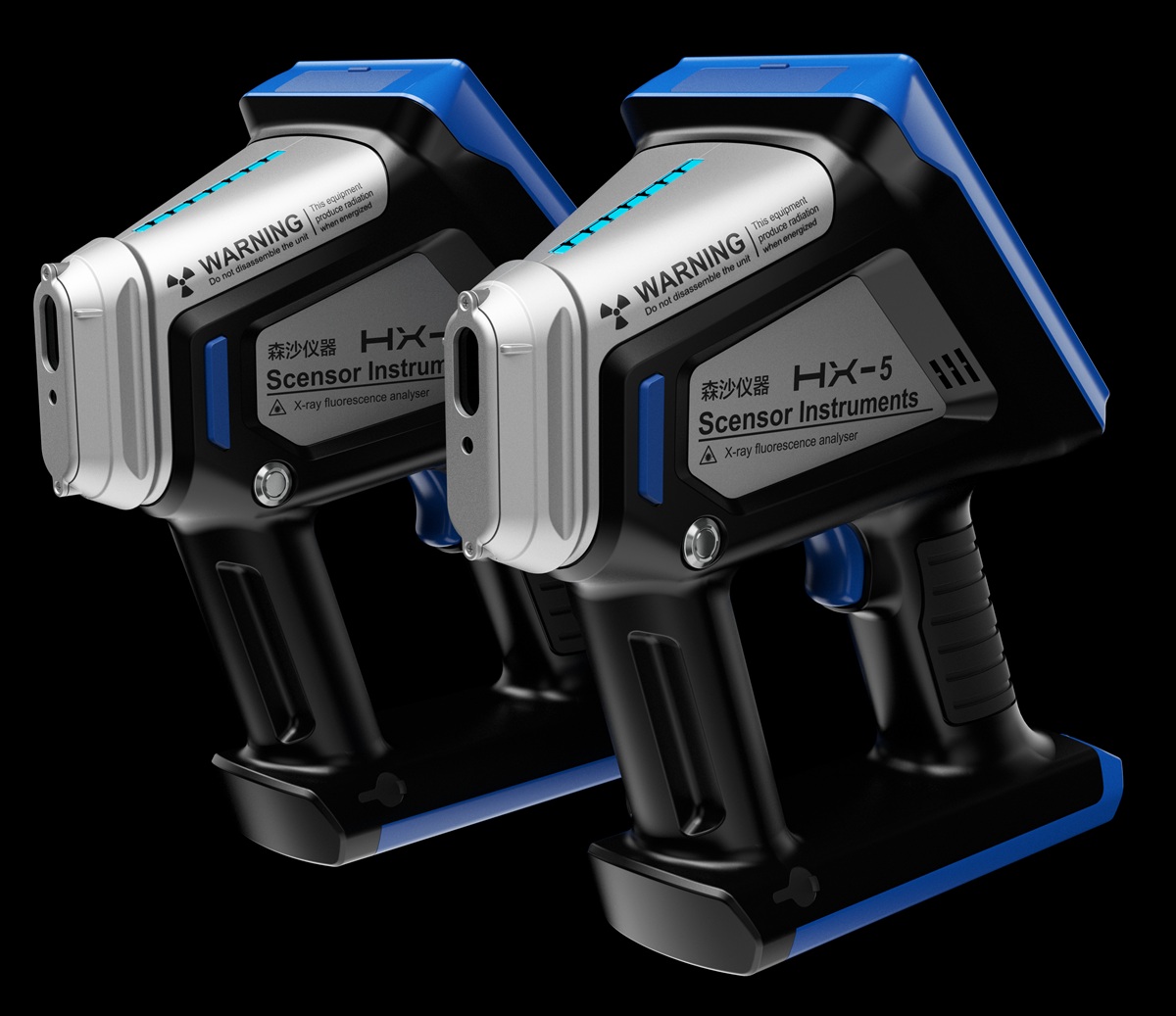
Handheld XRF empirical coefficient method custom development and calibration curve building
Quantitative Core

Three-Layer Correction Pipeline: From Raw Intensity to Concentration

Scensor's quantitative pipeline nests three correction layers from outer to inner with fixed order and independent toggles: bag correction restores bare-sample net intensity, scatter internal-standard normalization compensates matrix variation, and inter-element influence-coefficient regression maps intensity to concentration (I to C).

Outer

1 · Bag Profile Correction

For PE / PP / Mylar film bagged measurement, low-energy attenuation is corrected by energy segment via an equivalent-attenuation fingerprint (with Compton/Rayleigh scatter signature, validity period and drift alert) to restore bare-sample characteristic X-ray net intensity.

Middle

2 · Scatter Internal Standard

Uses the Compton (incoherent) / Rayleigh (coherent) scatter peak or C–R ratio as internal standard to compensate dark matrix, density and average atomic number (mean Z) variation; supports a shared reference or per-element reference with energy windows.

Inner

3 · Inter-element Correction + Fit

Influence coefficients compensate inter-element absorption-enhancement crosstalk; zero-forced / linear / quadratic curves complete the I→C regression, with curve terms and influence coefficients solved together in one AUTO-SOLVE.

Lucas-Tooth & Pyne (1961) intensity-based influence-coefficient kernel:
Ci = r0 + Ii · ( ri + Σ rin · In )
Ci=concentration of element i · Ii=net intensity (after bag + normalization) · In=interfering element intensity · r0=intercept · ri=slope · rin=influence coefficient of n on i

Selectable Algorithms

Influence-Coefficient & Normalization Matrix

Model / Strategy Mathematical Nature Best For
Lucas-ToothIntensity-based, iteration-free influence-coefficient regressionFew standards, handheld field calibration — default kernel
Lachance-TraillClassic concentration-based matrix-correction coefficientsMany standards, wide range, weak enhancement
Rasberry-HeinrichDual-coefficient model separating absorption and enhancementStrong-enhancement systems: Fe-Cr-Ni stainless, nickel alloys, iron-rich ore
Compton internal standardNet intensity ÷ ICompton, no closureSoil, environmental, ore — light dark-matrix samples
SUM→100% closureConcentration total normalization, FP-style closureFull-mass alloy systems
Piecewise calibrationIndependent curve + coefficient set per concentration segmentWide dynamic range: zero-forced low segment + quadratic high segment

A rule engine recommends normalization and calibration schemes from standard concentration distribution and key elements (KEY/MID/OFF) with auditable rationale — not a black box; engineers can override step by step.

Modeling Workflow

On-board Method Builder: Six-Step Wizard

1 · STD Standards

Enter certified standard true concentrations (% / ppm / mg·kg⁻¹), importance and target ranges as regression dependent variable C.

2 · METHOD Conditions

Fix excitation: tube voltage kV, current µA, filters, integration time, multi-stage; define analytes and lines (Kα/Kβ/Lα/Lβ).

3 · INT Intensity

Measure each standard, take characteristic-line net intensity and scatter-channel intensity after background subtraction, apply bag Profile.

4 · NORM Normalization

One of four mutually exclusive strategies: None / SUM→100% / shared internal standard / per-element reference, with keV energy windows for scatter references.

5 · CAL Calibration

Choose curve type and influence-coefficient model, select interferents, AUTO-SOLVE coefficients; supports piecewise calibration with per-segment coefficient sets.

6 · VALIDATE

R², RMSE, predicted-vs-true slope, LOOCV leave-one-out cross-validation, residual outlier removal and re-fit; publish once slope ≈ 1.

Terminology

Key XRF Method-Development Terms

Net Intensity

Background- and overlap-subtracted characteristic X-ray peak-area net counts — the independent variable of empirical regression.

Matrix Effect

Absorption and secondary-fluorescence enhancement from co-existing elements, making intensity non-linear with concentration.

Fundamental Parameters (FP)

Standardless / few-standard quantification from atomic constants and full-spectrum absorption-enhancement, usually with closure normalization.

LOD / LOQ

Limit of detection / quantification set by background noise and sensitivity; tied to integration time, filters and line selection.

Compton / Rayleigh Scatter

Incoherent (Compton) and coherent (Rayleigh) scatter peaks — the physical basis of scatter normalization, reflecting mean mass absorption.

LOOCV

Leave-One-Out Cross-Validation — a more honest generalization measure than in-sample R² when standards are few.

User Factors

Type Calibration light path: measure known samples for slope/intercept correction, layered with full empirical modeling.

SDD Detector

Silicon Drift Detector — high count-rate, high-resolution detector that governs peak separation and net-intensity quality.

FAQ

Method Development FAQ

Can distributors build their own calibration curves with their own standards?

Yes. The on-board method builder opens the full empirical coefficient method. Distributors import certified reference values, measure net intensities per element, build zero-forced/linear/quadratic calibration curves, and compensate inter-element absorption and enhancement with Lucas-Tooth, Lachance-Traill or Rasberry-Heinrich influence-coefficient models.

How does the empirical coefficient method differ from FP?

FP uses atomic constants and full-spectrum absorption-enhancement with 100% closure, ideal for alloys and broad-matrix unknown screening; the empirical method regresses I→C from known standards with influence coefficients, reaching certificate-grade accuracy on familiar material families. Practice: FP screens, empirical methods quantify.

How are matrix effects corrected for dark-matrix soil and ore?

For soil and ore where O/C dark matrix is unmeasured and concentrations sum far below 100%, the platform supports Compton scatter internal-standard normalization: net intensity ÷ I_Compton compensates mass-absorption-coefficient variation — the alternative when FP closure fails, for ppm to low-percent.

How is a custom method's accuracy and robustness evaluated?

VALIDATE provides R², RMSE, predicted-vs-true slope (ideally ≈1.00), LOOCV cross-validation and residual outlier analysis; outliers can be removed and re-fit. With few standards, LOOCV is more honest than in-sample R².

More Applications

Explore Other Handheld XRF Applications

Want to encode your standards and know-how into a dedicated method?

Contact the Scensor method-development team to discuss empirical-coefficient modeling, custom calibration and XRF development partnership.